Facade-free access with Custers
We are frequently asked about facade-free working. Eric Mommers, HQSE Manager at Custers, is happy to explain.
As a craftsman, you want to deliver top-quality results. Whether you are painting, plastering, or pointing: the scaffold needs to be positioned close to the wall without handrails or stabilizers restricting your freedom of movement.
We call this facade-free assembly. It sounds like the ideal way to work, but in practice, this is the configuration where most mistakes occur. In this blog, we combine official laws and regulations with Custers’ robust, practical solutions. This ensures you are both legally compliant and standing safe.
The Legal Framework: The 15-Centimeter Rule
The foundation of facade-free working is anchored in the official safety guidelines (such as the Volandis "A-blad" for mobile access towers). This often causes confusion, but the basic rule is simple:
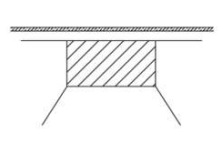
Distance < 15 cm: Is the platform of your scaffold positioned less than 15 centimeters from the facade? If so, you are permitted to omit the guardrail on the wall side for one section of 2 meters. In this specific case, the facade itself serves as the official "fall protection."
Please note: Some competitors offer configurations where all guardrails on the facade side are missing. This is neither legally permitted nor safe!

Distance > 15 cm: Is the gap larger? If so, both a hip-level handrail and a knee rail are mandatory on the wall side.
Many builders misjudge this distance. A scaffold tube is approximately 5 cm thick, and due to the positioning of the wheels, the platform is often further away than it appears at first glance. When window frames, sills, or roof overhangs are present, the gap frequently exceeds 15 cm. Therefore, always double-check and measure!
Wind Force: Regardless of the configuration, work must stop at wind force 6 Beaufort (more than 14 m/s). At this point, the scaffold must be moved to a wind-free area, receive extra anchoring, or be dismantled.
The Challenge: Stability versus Workspace
A freestanding scaffold requires four stabilizers for a solid foundation. If you want to work directly against the facade, the two inner stabilizers are often in the way.
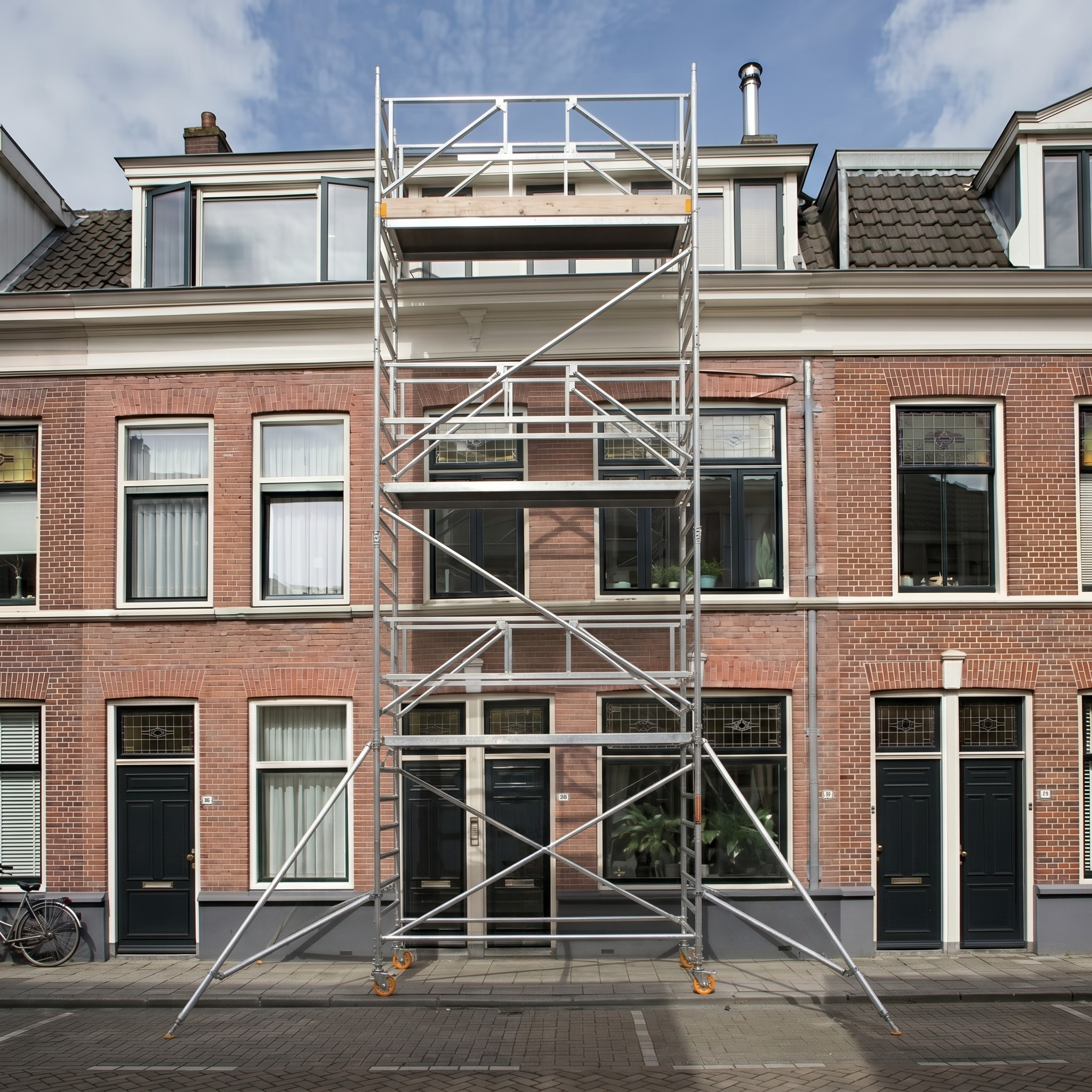
The simplest option is to rotate the two inner stabilizers so they run parallel to the facade. Do you want absolutely nothing between you and the wall? Then the inner stabilizers can be removed. With a Custers scaffold, you handle this as follows:
Outer Stabilizers: Fully extend the two stabilizers on the street side (the free side) to provide maximum counterweight.
Install Distance Holders: At the highest point, two distance holders must be mounted that rest against the facade.
Extend the Wheelbase: Ensure the wheels in the base are positioned as far outward as possible (in the longitudinal direction of the beam) to increase the supporting surface.
Remove Guardrails: Provided the distance to the facade is less than 15 cm, you may remove the hip and knee rails from the working platform on the facade side.
Why Facade-Free Working is Safer with Custers
Not every mobile access tower on the market is suitable for this specific setup. Custers mobile towers distinguish themselves in three key areas:
Diagonal Braces: Unlike many other providers, Custers uses extra diagonal braces in the wide Safe Guard mobile towers. This provides essential additional rigidity to the construction.
Suitable for Double Platforms: Because the stability is derived from the braces, the Mobile Guard towers are ideally suited for facade-free work on a wide (double) working platform. This is also possible with Safe Guard towers by placing an extra platform at the desired working height. A wider scaffold inherently offers greater stability.
System Compatibility: You can work facade-free using both the Mobile Guard and the Safe Guard leading guardrail systems.